
Spec-Driven Development: Why AI Code Generation Needs a Spec
Table of contents

Introduction
Your team just spent 2 weeks building a feature with an AI coding assistant. The pull request looks clean. Tests pass. Then your senior architect reviews it and finds the module solves the wrong problem. The AI generated exactly what the prompt described. The prompt just described the wrong thing.
This scenario plays out across engineering organizations every week. According to a GitClear analysis of 211 million lines of code, AI-assisted codebases show a 39% increase in churn (code rewritten within two weeks of being committed). The code gets written faster. It also gets thrown away faster.
The issue is not the AI. The issue is what you feed it.
The Prompt-and-Pray Problem
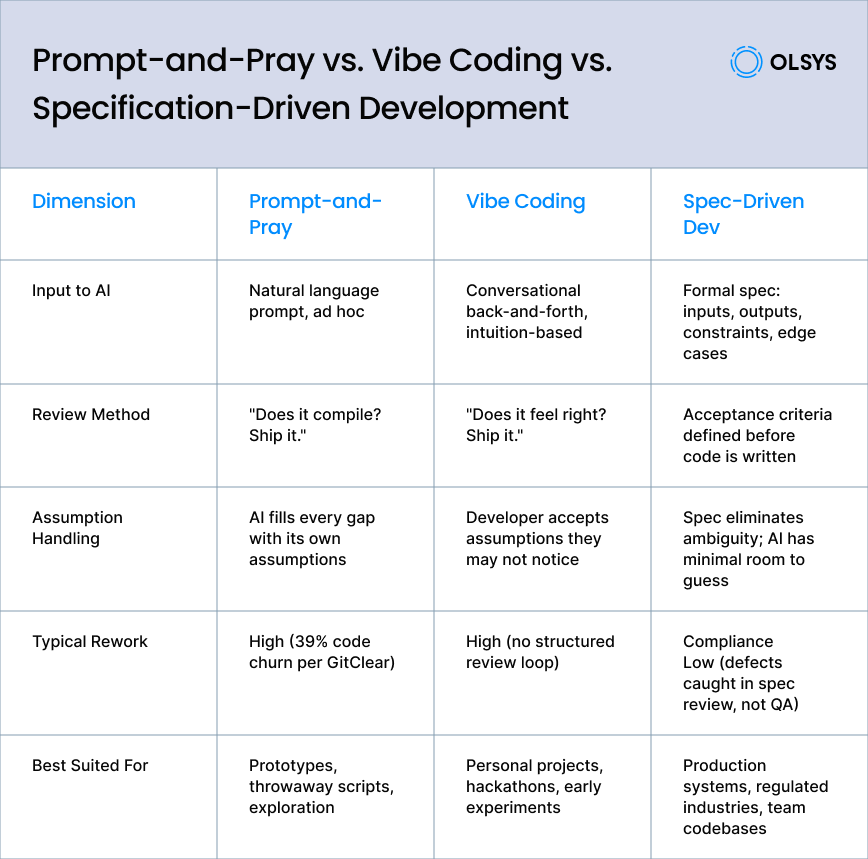
Most teams adopting AI code generation follow a pattern that looks roughly like this: a developer opens a chat window, types a natural language description of what they want, and hopes the output is close enough to ship. If it is not, they refine the prompt. Then refine again. And again.
Industry shorthand calls this “prompt-and-pray.” A newer variant, “vibe coding,” takes it further: developers accept AI output based on whether it feels right, skipping structured review entirely. Andrej Karpathy coined the term in early 2025, and the practice spread quickly through teams under pressure to ship.
Both approaches share the same structural flaw. They treat AI code generation as a conversation instead of an engineering process. Conversations are ambiguous by nature. Engineering processes are not supposed to be.
When a developer prompts an LLM with “build me a user authentication module,” the model fills in every blank with assumptions: session management strategy, token expiration policy, password hashing algorithm, rate limiting behavior, error response format. Some of those assumptions will match what you needed. Some will not. You will not know which until something breaks in production.
What Specification-Driven Development Actually Means
Specification-driven development is not a new framework or a tool you install. It is a discipline: write the spec before you write the prompt. The spec defines inputs, outputs, constraints, edge cases, data contracts, and acceptance criteria at a level of detail that leaves the AI with minimal room to guess.
Think of it as the difference between handing a contractor a napkin sketch versus handing them architectural blueprints. The contractor (the AI) builds what you give them. The quality of the output mirrors the quality of the input.
A practical specification for the authentication module example would include: supported authentication methods (OAuth 2.0, email/password), token type and expiration window (JWT, 15-minute access, 7-day refresh), password requirements (bcrypt, minimum 12 characters, breach database check), rate limiting rules (5 failed attempts triggers 15-minute lockout), and the exact error response schema with HTTP status codes.
That spec turns a vague prompt into a constrained generation task. The AI still writes the code. It writes the right code.
Why Spec Quality Equals Output Reliability
AI coding tools are pattern-completion engines. They predict the next token based on context. A richer, more precise context produces more predictable output. A vague context produces creative improvisation, which is exactly what you do not want in production software.
We have seen this play out across client projects at Olsys. When our teams introduced specification-driven workflows on an AI-assisted rebuild of a legacy financial reporting system, defect rates during QA dropped by roughly 40% compared to the first sprint.
How to Start Without Overhauling Everything
You do not need to rewrite your entire development process. Start with the components where ambiguity costs you the most: APIs, data transformations, and integration points.
For each of those, write a one-page spec before any AI prompt. Define the data contract (field names, types, validation rules).
List the error states and expected responses. Specify performance constraints (response time under load, throughput requirements). Document the security requirements (authentication, authorization, input sanitization).
Feed that spec into your AI coding tool as context. The difference in output quality is immediate and measurable.
Teams that adopt this approach report spending less time in code review arguing about implementation decisions, because those decisions were made in the spec.
The Spec Is the Guardrail
AI code generation is getting faster every quarter. Models are larger, context windows are wider, and the tooling keeps improving. None of that changes the fundamental constraint: the AI builds what you describe. If you describe poorly, you get code that looks right and behaves wrong.
Specification-driven development treats the spec as the product, and the code as its derivative. That inversion matters. It shifts engineering effort from debugging AI output to defining what correct output looks like, which is where engineering judgment belongs.
The teams that get the most from AI code generation will be the ones that invest in the input, not the ones that pray over the output.
Olsys builds AI-led development workflows grounded in specification-driven methodology. If your team is adopting AI code generation and wants to reduce rework instead of multiplying it, let’s talk.