The Factory Over the Product: AI-SDLC & Insider Theft
Table of contents

The Custom Software Development sector is undergoing its most profound structural shift since the cloud computing revolution. Yet beneath the industry-wide enthusiasm for soaring developer velocity lies a critical, unspoken risk to service-based IT businesses: the potential for total exfiltration of the company’s operational core.
Why AI-powered development creates a new kind of insider risk
Custom software development is going through a quiet but serious shift. Everyone talks about how AI dramatically increases developer speed. Almost no one talks about the other consequence of this change — a new and quite dangerous risk for service-based IT companies.
In the past, the business of these companies rested on two things: people and the code they wrote for clients. If an employee left and took project code with them, it was unpleasant. There could be reputational or even legal consequences. But the stolen code itself quickly lost value. Without the team that understands, maintains, and evolves it, it became dead weight. You lost that person’s expertise, but the company’s core processes remained in place.
With the rise of AI approaches, everything changed.
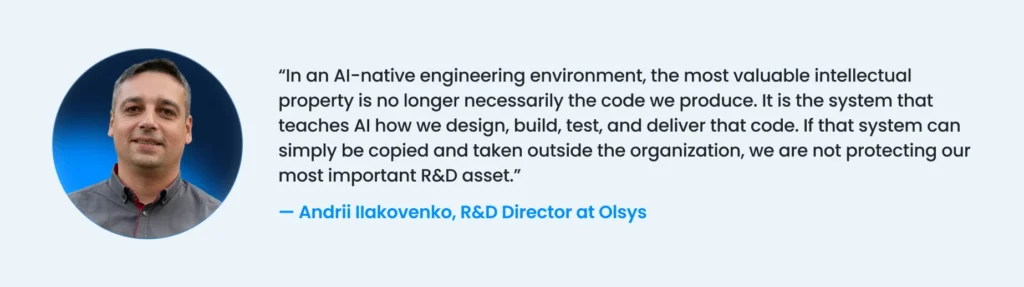
Strong engineering teams are no longer just building code. They are building a factory that produces the code — a collection of prompts, agents, rules, configurations, specifications, and orchestration layers. This system is what allows one person to deliver in a few hours what previously required a team and weeks of work. And this factory is now the easiest and most valuable thing to steal.
The core of the problem
This risk becomes especially sharp in approaches like Spec-Driven Development and work with agentic tools. They are built on the principle of “everything as code.” System prompts, agent rules, architectural constraints, coding conventions — all of this usually lives in the repository as ordinary text files (.cursorrules, .claude.json, specification folders, and similar).
For agents to work well and predictably, developers need direct and convenient access to these files. This creates an unpleasant paradox: the better and more precisely you tune your AI system, the easier it becomes to take the whole thing with you. Months of experimentation, prompt refinement, testing, and orchestration setup get compressed into a relatively small folder that can simply be cloned.
Economic implications for custom development services
This hits the business model of service companies particularly hard.
An individual who contributed little or nothing to the original R&D can leave and fairly quickly launch an independent AI-native consultancy. Their marginal cost of delivery immediately matches yours, while their initial investment in building the system is close to zero.
What used to be a durable competitive advantage — years of accumulated process knowledge, refined workflows, and internal tooling — can now be replicated in days. For companies whose main offering is custom development capacity, this compresses margins and makes differentiation much harder.
Why traditional protection barely works
Familiar security tools and legal mechanisms perform poorly here.
Data Loss Prevention systems usually look for passwords, personal data, large volumes of source code, or other obvious indicators. Text prompts, markdown specifications, and JSON configs are often treated as ordinary low-risk work files.
Standard NDAs and non-disclosure agreements protect client code and the company’s own algorithms quite well. But system prompts, agent instructions, and orchestration configurations sit in a legal gray area in many jurisdictions. They are difficult to enforce unless you have explicitly registered and treated them as trade secrets from the beginning. In practice, most companies discover this gap only after someone has already left with the full set of files.
Strategic countermeasures
Completely locking developers out of the AI system is not realistic — the system simply stops working properly. The goal is to raise the cost and complexity of stealing the factory itself.
1. Architect a real separation of duties
Move critical process intelligence out of individual project repositories.
- Keep core agent orchestration, system prompts, and tool definitions behind an internal platform or API gateway.
- Use just-in-time context injection: the necessary instructions are delivered at runtime through secure secret managers or internal services. Developers interact with execution results but do not retain persistent local copies of the full orchestration logic.
2. Make stolen configurations incomplete
Prompts should not function as standalone assets. Their real power must depend on live integration with proprietary company resources – vector stores with historical architecture decisions, domain-specific rule engines, security and compliance policies. Without active, authenticated access to this internal knowledge layer, a stolen set of prompts and configs remains an empty shell.
3. Shift the value proposition toward things that cannot be cloned
If process execution becomes easier to copy, the company’s durable value has to move elsewhere:
- deep domain-specific expertise and business integration;
- regulatory compliance, liability coverage, and formal assurances (SOC2, ISO, GDPR and similar);
- institutional trust, governance, and long-term SLA commitments that enterprise clients actually pay for.
Conclusion
Companies that continue to store their most valuable AI work as open text files scattered across repositories are effectively creating the conditions for former employees to quickly copy their business model.
The future will likely belong to those who not only started using AI tools early, but also managed to separate day-to-day execution from access to the actual operating system that makes that execution possible.